Showing posts with label Midnight Mass.. Show all posts

Tuesday, October 01, 2024

Midnight, Mass. Trade Paperback Collection Now Available


Collecting the entire 8-issue series, Midnight, Mass., written by me with pencils by Jesus Saiz, inks by Jimmy Palmiotti, colors by Noelle Giddings and Kevin Somers, lettering by Ken Bruzenak and John Costanza, and edited by Heidi MacDonald is now available at your local comic book store and book store. 

The series follows the exploits of paranormal investigators Adam and Julia Kadmon as they take on a variety of monsters, strange cults, ghosts, and a new personal assistant. 


Thursday, March 28, 2024

Midnight, Mass. Trade Paperback Collection Coming In Fall 2024


Through it's Black Label imprint, DC Comics will be releasing a 208 page trade paperback collection of the 8-issue series, Midnight, Mass. on October 1, 2024. It will sell for $16.99 retail. You should be able to pre-order it through your local comic book store in the next few months. 


Midnight, Mass. follows the adventures of paranormal investigators Adam and Julia Kadmon from their home in Midnight, Massachusetts. It was written by me with pencils by Jesus Saiz, inks by Jimmy Palmiotti, colors by Noelle Giddings and Kevin Somers, letters by Ken Bruzenak and John Costanza, and covers by Tomer Hanuka. It was edited by Heidi MacDonald and Zachary Rau. 


Here's DC's press announcement:


Sunday, December 04, 2016

Now on Kindle


While it has never been collected in a trade paperback collection, for those of you who may have missed it, the first five issues first series of Midnight, Mass. is now available to read on Kindle. Amazon has many other comics I've written on Kindle as well. See the links below.


Saturday, January 18, 2014

Alternate Midnight, Mass. Covers


Check out these cool alternate Midnight, Mass. covers by Jeremy Darby which he made for a class assignment, including one for a non-existent 3rd story arc.

Monday, December 30, 2013

Questions Pertaining to Me and My Characters


Now to answer the last of this month's questions before venturing into the new year. 


Ben Z said...
If you could be any one of your characters, who would you be?

What character of yours would you most like to be able to meet in real life?


Until you asked this, Ben, I'd never given it any thought. I try to make my characters appealing in some way, and of course all of them are really me, or some aspect of myself, but that's not really what you're asking. So, I've given this question some thought. 

I'm guessing most people would expect me to pick David Kim. Immortality with a perfect memory have their appeal, and David's a nice enough and really smart guy, but the rest of his life is a bit of a mess and, knowing what is planned for him, only gets messier. So, I think I'll pass. There's also something about the idea of never getting old while everyone you know ages and dies around you -- forever, that does not hold any real appeal. 


I'd have to say that out of all my characters the one I'd probably most want to be would be Julia Kadmon, but then I'd probably rather be married to Julia Kadmon, which means I'd have to pick Adam Kadmon. He's good looking, never has to worry about money, lives in a great house, is a master magician and paranormal investigator in a world where that stuff is real, and has an amazing wife, so I'd pick being him (even though Julia is much cooler than he is). 


As far as which of my characters I'd want to meet, it would, again, probably be the Kadmon's because of all the stories they'd have to tell about what they've done. It would also be a tad safer than meeting Magellan.


I would want to meet him though because meeting a genuine monster would be really cool, and the world would be a more interesting place with them in it.


Monday, October 28, 2013

31 Days of Halloween - Day 28


Monsters: The monster council of elders

Appearance: "The Edge of Civilization - Part 2", Midnight, Mass. #3, August, 2002. "Here There Be Monsters - Part 2: Orion" Midnight, Mass. - Here There Be Monsters #2, April, 2004. "Here There Be Monsters - Part 3: Abraham" Midnight, Mass. - Here There Be Monsters #3,  May,  2004. "Here There Be Monsters - Part 6: Magellan" Midnight, Mass. - Here There Be Monsters #6, August, 2004. 

Jesus Saiz: Penciller, Jimmy Palmiotti: Inker, Ken Bruzeniak: Letterer, Noelle Giddings: Colorist, Digital Chameleon: Seperations, Tomer Hanuka: Cover Artist, Zachary Rau: Assistant Editor, Heidi MacDonald: Editor. 

Paul Lee: Artist, Sherilyn Van Valkenburgh: Colorist, Janice Chiang: Letterer, Tomer Hanuka: Cover Artist, Zachary Rau & Joan Hilty: Editors.


Just as Magellan was the leader of the rebel monsters bent on taking for their own a portion of human civilization's trappings, I wanted the general populace of monsters, okay with their existing place in the world,  to have representation. Most of the rebel monsters tended to be young, so it made sense to go in the other direction with the Council of Elders, though among its representatives are young clerks and bodyguards. 


The absolute leader of the Council is Abraham, who I wanted to be something like the Creature from the Black Lagoon as elder statesman. He was given the name Abraham, because of its connection with leadership in the bible, and in U.S. History. It didn't occur to me until much later that Hellboy also featured a fishman named Abraham, although they are very different characters. 


The Abraham of Midnight, Mass. is uptight, stodgy, and not always polite, or patient. Above is my original sketch. Below you can see him along with Stagyrites, Baby Doll, and Mizra. 


Stagyrites, with her face pulled back to a knot on the top of her head, wired to knife blades, is more bodyguard than council member, though she's not afraid to chime in her opinions. 


Babydoll was meant to be an unexplained presence whose visual look begged for an origin story. 


Dulcarnon was a somewhat childlike clerk of the Council, but his anatomy was supposed to imply a fast predatory creature, that like Arturo, belied his pleasant nature. 


The full story of the Council remains to be seen, but their departure, seen above, is one of my favorite visuals from the series. 

Friday, October 25, 2013

31 Days of Halloween - Day 25


Monsters: Magellan and Arturo

Appearances: "The Edge of Civilization" Midnight, Mass. #2-3. July - August,  2002. Midnight, Mass. - Here There Be Monsters #1-6. March - August,  2004. 

Jesus Saiz: Penciller, Jimmy Palmiotti: Inker, Ken Bruzenak: Letterer, Noelle Giddings: Colorist, Digital Chameleon: Separations, Tomer Hanuka: Covers, Zachary Rau: Assistant Editor, Heidi MacDonald: Editor

Paul Lee: Artist, Sherilyn Van Valkenburgh: Colorist, Janice Chiang: Letterer, Tomer Hanuka: Covers,  Zachary Rau & Joan Hilty: Editors


When creating the monsters for Midnight, Mass., I decided that there would be three kinds: monsters from folklore and mythology; modern monsters that I would create that served as avatars for modern  conditions such as work stress, consumer greed, automobile accidents, technology, pesticide use, and so on; and monsters of a general nature who have been around for a long time, but are made up and not something akin to Goblins, werewolves, giants, or things of that nature. 

Magellan and Arturo belong to that latter category. 

I also wanted to distinguish them by not making them specifically mammalian, reptilian, plant-like, or some other obvious deviation from the established Kingdoms of life on earth. 

For Magellan, who was meant to be something of a rebel leader among monsters, I wanted to give him strength and majesty -- the suggestion of him being a warrior prince. I wanted to suggest something lion-like with his features without being literal. So he's big, with widespread features on his face which is surrounded by a halo of head tails, meant to suggest a mane, without being made of hair. I also wanted him to be bright red, the color of violence, passion, rage, blood, and the red carpets and capes of fairy tale kings. He was also meant to be the only thing colored red in the comics other than things that were meant to be associated with him, so that subconsciously the reader would connect these elements to Magellan without realizing it. My first drawing of him can be seen above. 


Personality-wise, I wanted to get away from monsters that simply growled and roared (though he does some of that too, and it's sometimes a sense of shame for him, and sometime pride, that he does it). I wanted him to be smart, articulate, able to use tools, read, and also perform magic. Aggravated by the long held tradition of monsters being outcasts confined to the woods, caves, mountains, and other places outside of human habitation areas, he craves what humans have -- houses with electricity and running water, refrigerated food, and so on, and after initially buying a home of his own, from which he is driven, he decides to lead a monster revolt against the humans in order to take entire towns by force. 

Above is Jesus Saiz's initial sketches of Magellan, and below a finished page from issue #2. 


Arturo was meant to be more of a contrast with Magellan than a sidekick. The above photo from photographer Daniel Lee of  human/snake hybrid is what started steering me towards the character that eventually became Arturo. I liked that the creature above doesn't really have reptilian features, but suggests them and also still looks human at first glance. I really liked the widespread layout of the facial features, but envisioned the hair as being something more akin to coral -- bony outgrowths coming up from the skull. 

Arturo became a lanky, sarcastic, youthful character who smoke cigarettes, drank alcohol and watched tv. There was something about him that was somewhat endearing, probably because it was attached to a monstrous figure, though it would probably have been more annoying if it were attached to a human character. I really liked that he had these more endearing traits so that when he did something terrible and violent it was shocking and also served to remind the readers that even though these monsters are unlike typical monsters in how they act and speak, they're still monsters and do monstrous things. 


I also decided that he should be green as a contrast to Magellan, and to give him a colder look that matched his hidden violent nature. 

Arturo was actually meant to be killed off at the end of the first issue of Midnight, Mass. - Here There Be Monsters, but he ended up so completely stealing that issue that I became too fond of him to want to get rid of him. Part of that came from Paul Lee's partial redesign seen below. The finger/crag leg like growths where the coral like structures were, gave him a lot more expression as did the slight changes to the eyes and mouth. Arturo became a lot of fun to write and his character wound up developing a little more complexity than I'd planned for and provided for a lot of comedic moments throughout the series, but also some jaw dropping moments of horrible violence. 


Thursday, October 17, 2013

31 Days of Halloween - Day 17


Monster: Orion

Appearance: "Here There Be Monsters - part 2: Orion" Midnight, Mass. - Here There be Monsters #2. April 2004. 

Paul Lee: Artist, Sherilyn Van Valkenburgh: Colorist, Janice Chiang: Letterer, Tomer Hanuka: Cover, Zachary Rau & Joan Hilty: Editors. Midnight, Mass. created by John Rozum


One of the things that was important to me about Midnight, Mass. is that the monsters had to be unique. While there were things such as vampires, and creatures out of folklore and mythology, the core monsters had to be creatures that stood apart from the typical go to monsters. 

The monsters of Midnight, Mass. also differed in that they were fully fledged characters, people with their own beliefs -- both personal, and as a group, personalities, quirks, complex emotional states, and so on, rather than mindless snarling beasts. Even so, there was always a reminder that as nice as some of them may seen, these creatures are in fact monsters. 

Orion was one of the friendlier ones, and he gets a fair amount of development for the one issue that he appears in, with an implied backstory of tremendous scope. As the above page of his origin implies, Orion is a sentient, man shaped section of the night sky, named Orion because it was the only constellation his human "mother" knew the name of other than the big dipper. 

He has enhanced eyesight, he can disguise himself by appearing as what people expect to see. he can fold himself flat and drift across the ground like the shadow of a passing cloud. 


His body isn't just filled with space and stars and planets. It is space and stars and planets. You could even visit them if you knew how. 


Friday, October 11, 2013

31 Days of Halloween - Day 11


Monster: Reprobus

Appearance: Midnight, Mass. - Here There Be Monsters #5 - "Here There Be Monsters, part 5: Reprobus" July 2004.

Paul Lee: Artist, Sherilyn Van Valkenburgh: Colorist, Janice Chiang: Letterer, Harvey Richards: Assistant Editor, Joan Hilty: Editor. 


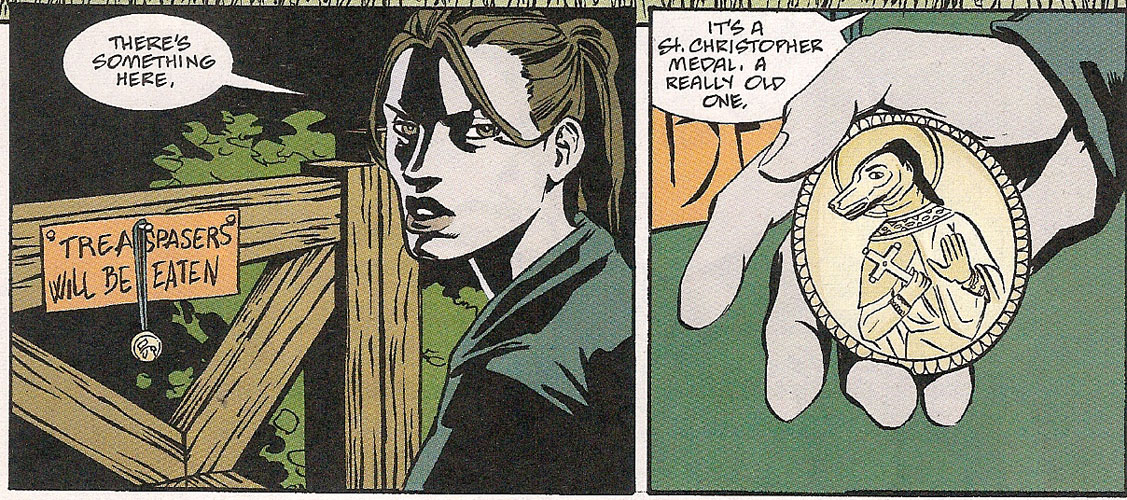
Reprobus made his initial appearance on a St. Christopher medallion in Midnight, Mass. #2. Nothing much was said about him, though the medallion was clearly meant as an emblem of protection, and this emblem was being used by monsters. When a police officer asked why St. Christopher looked like that he was told that it's what he actually did look like before the Catholic Church made him more palatable by depicting him as a human being. Don't believe me? Just look...


St. Christopher's sainthood has been rescinded, but people still follow him. He's best known as the patron saint of travelers, but he also covers bachelors, storms, transportation, epilepsy, gardeners, toothache, and holy death. In Midnight, Mass., Reprobus was the patron saint of monsters. Below you can read the actual origin story of how Reprobus became St. Christopher, followed by the alternate story of how he became the patron saint of monsters. 


If anyone reading this lives in one of the Eastern European countries where St. Christopher is still occasionally depicted with the head of a dog and can obtain for me a medallion that depicts him this way, please contact me. I'd love to get my hands on one. 


Tuesday, October 01, 2013

31 Days of Halloween - Day 1


Monster: The Terrortactile

Appearance: "Bluebeard's Castle" Midnight, Mass. #1. June 2002. 

Jesus Saiz: Penciller, Jimmy Palmiotti: Inker, Ken Bruzenak: Letterer, Noelle Giddings: Colorist, Digital Chameleon: Separations,  Zachary Rau: Assistant Editor, Heidi MacDonald: Editor. Midnight, Mass. created by John Rozum


I've noticed over time that there are three motifs that reoccur with my monster creations; scissors, a lack of eyes, and hands where they don't belong. The terrortactile doesn't have any scissors (but could easily wield them) but does lack eyes and have a hand where one shouldn't be. Visually I think he's an effectively creepy looking creature. I say "he" because even though the terrortactile lacks genitals, nipples, a rectum, or body hair, it's built to look masculine. I also think this thing would lend itself really well to being adapted to the screen should the tv series ever see the light of day, or in a Midnight, mass. movie. 

Rather than say anymore about it, I'll let Adam Kadmon fill you in on the rest of the details. 


Wednesday, September 19, 2012

NBC To Bring Midnight, Mass. to TV


It's been officially announced, so now I can tell you as well. NBC has bought the rights to my comic book series, Midnight, Mass. which was published as two mini-series through DC's Vertigo line. This is the third time that this has happened and hopefully this time will be the charm that sees this come to fruition. I'm a bit more hopeful this time with the talent involved.

You can read more about it at Deadline.com .

Saturday, June 02, 2012

Writing Dialogue

Travis asks: I find that whenever I try to write dialogue, I have a lot of trouble really giving it a sense of life. Do you have any advice on how to write dialogue that doesn't just feel flat?

I don't know if I'm the best person to answer this, but I'll take a crack at it. 

Dialogue needs to accomplish one or more of the following (not in any order of importance): 

1. It needs to help define the character speaking the dialogue.

2. It needs to help define the relationship between the two characters interacting.

3. It needs to provide exposition that informs the reader in a manner that should feel natural and unobtrusive while providing the reader with details that help them understand the story.

4. It needs to help move the story forward. 

In terms of comic books (and movies) much of the above can, and should, also be accomplished visually rather than through dialogue.

My best advice really is:

1. Really understand who your characters are. This makes the job much easier overall, because this understanding informs how they will act, or react, in certain situations, and how they'll interact with a wide range of other characters. It will also make it much easier for you to figure out how they'll talk.

2. Figure out what needs to be accomplished in each scene. How much of this can be done through action and how much of this needs to be covered in dialogue. 

3. What are you trying to accomplish with the dialogue? Is someone merely giving information? Are you trying to demonstrate that the two characters have a history and are either comfortable with each other or uncomfortable? 


The page above taken from Midnight, Mass. #4 (with art by Jesus Saiz, Jimmy Palmiotti and Kevin Somers and lettering by John Costanza) is just this sort of use of dialogue. The story itself is not really moved along by it, and the amount of key information that serves the plot is minor, but it establishes Harmon (with the beard) as a really unlikable person, but yet someone with enough clout that Adam and Julia,  the wealthy stars of the story, will still come and work for him even though they can't stand him. 

4. Relax. Don't try too hard. Real conversation is peppered with awkward phrases, misused words and tangents that go off subject. While I don't recommend using "um" as a comma, or "like" as it's used in common speech, using asides is okay. Because so much of my work is fantastical in nature, I try to ground the fantasy in reality by balancing the fantastic with the mundane in the conversations occurring on the page. 


In the scene above from the never published Xombi Hanukkah Special (with art by Guy Davis and Noelle Giddings) the dialogue contains exposition about the people they are on their way to see but never reach (which happen to be Adam and Julia Kadmon from Midnight, Mass. ) with some mundane asides such as directions and comments about the weather and road conditions which while seemingly inconsequential make the conversation feel more natural and more real while at the same time signaling the danger to come. 


The two examples above go about contrasting the fantastic and the mundane in a different way. Both pages add interesting visual contrasts to keep the exposition in the dialogue from feeling boring or chatty. In the top example from Midnight, Mass. #1 (with art by Jesus Saiz, Jimmy Palmiotti and Hoelle Giddings and lettering by Ken Bruzenak) the purpose was to humorously contrast with boring business, which grounds the fantastic in the real world, with the weird activity in the background. 

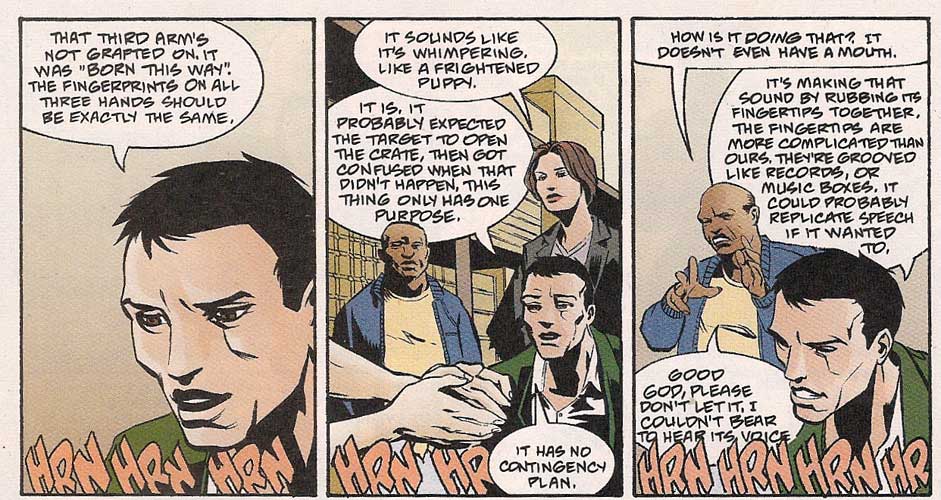
In the second example from Midnight, Mass. - Here There Be Monsters #2 (with art by Paul Lee and Sherilyn Van Valkenburgh and lettering by Janice Chiang) a lot of things are happening at once. An extract from a longer scene, the main action features the Kadmons dealing with a haunted severed hand and the malignant spirit inhabiting it. The main purpose is to lend visual interest to a scene in which a lot of exposition and speculation is given about a separate case which is the focus of the story as a whole. By having the characters discussing something that doesn't have anything to do with the action at hand, I'm also showing that dealing with supernatural threats is just a job to them, just as guys roofing will talk about something unrelated to what they are actually doing when they lay down a roof. The dialogue also contains material that illuminates the relationship that Adam has with his grandmother and gives hints about the mysterious nature of his absent grandfather. 

The key is to tell only what you absolutely need to to keep the reader from feeling lost and to allow them to move forward with the story, but also to tell enough so that they can fill in the missing blanks on their own, or feel like they are filling in the blanks so that they become caught up in the story enough to want to stay with it to find out if they are right. 

As long as you have that bare minimum of essential information present, you can start building your characters and the world they inhabit through the way they speak, make asides, joke, criticize, and so forth when they are exchanging this information, and will make it seem more like real people talking. This also gives you room to breathe and to allow the conversations to play out in a less forced manner, and you may discover something about what you're writing that surprises you and your readers, and adds to the quality of your story.

For myself, I find that by not planning out more than just the barest bones, I can let the characters respond to one another as well as the situations they are in in a spontaneous manner that seems to be coming more from them and less from me which also makes what they say feel more natural. When you do it this way you'll know you're doing it right when you want to have one of your characters say something and realize that they never would say what you need them to. 

Remember also that fictional characters don't really talk with one another like real people do. It's more of a stylized representation meant to approximate and suggest how real people sound when they talk with one another. Depending on the medium, the abstraction of this stylization is more or less apparent. Plays are probably the least like real speech. Comics, because the dialogue is as much a visual element as the images, are abbreviated approximations of real speech otherwise the pictures would be completely covered with dense word balloons. 

The two exercises which may help you are to go sit down in a Starbucks and eavesdrop in on a conversation happening at the table behind you. While you're listening, write down what you hear, and then later reread this as if it were a scene. What's being told in that conversation? What is essential to the scene? What's not essential, but helps define the people who are talking? What should be cut from this conversation? The other exercise is to take a pair of your characters and simply write a back and forth exchange of dialogue between them. The conversation should have absolutely nothing to do with your story. They can talk politics, discuss a book they both read, or a meal they've eaten, or gossip about someone they know. This will give you a better handle on them as characters and on how they talk and should help improve how you write dialogue. 

I don't know how much of this will really help you, or anyone, and I'm not sure how useful those examples are that I've provided. It's really just some thoughts I have on the process based on your question. Feel free to ask me more if you want me to elaborate, or add something I left out. 


Wednesday, May 23, 2012

4 Questions, 4 Answers


Ben Z. asks...

1) Supposing you are in the deep woods of Michigan, how are the ticks this year? Do you have struggles with ticks, and if so, how do you approach the struggles? 


That biographical information about me on my website was not entirely true. I did live in Michigan for a time, but not in the deep woods. That photograph that allegedly is me was chosen because it looked nothing like me and that man looked like a real character. I live in New England now pretty well surrounded by woods and the ticks are a huge annoyance. You can't walk outside without picking at least one of them up. The deer ticks are not much bigger than this: .  so it's not easy to find them on you and they are the ones to worry about. I blame the mild winter. 


I usually deal with them by staking a small child down to the ground and once all of the ticks have attached themselves onto he/she, I know it's safe to go outside. 

2) Do you feel the scripts for Kobalt #17-19 could be successfully reconfigured to feature new characters (other Company characters or ones that you own)? Or were the scripts only viable with the Kobalt character and in the context of the 16 other issues?


I don't think it would be impossible to reconfigure those scripts for other characters, but there isn't as much point to doing it. They were really meant to serve Kobalt. One of the stories I did reconfigure as what would have been Midnight, Mass. #9. Sadly that series ended with issue #8. It worked really well for Midnight, Mass., and was probably truer to that particular series, but it was actually a stronger issue of Kobalt. I've taken the villain for that story and decided to include them in a young adult novel I've been slowly pulling the pieces together for. Don't look for it anytime soon. 

3) Have you ever considered a creator-owned series that used your ideas for the post-Morrison Doom Patrol as a starting point? 


Not really. Most of the ideas I had for that series were very specific to the Doom Patrol and its characters. Some of the material was cannibalized for Xombi, and some of it was going to wind up in Midnight, Mass., had that series continued. Some of it may end up in something else I'm working on, but it's really pulling out bits and pieces and applying them to other material rather than using them as a starting point to develop new characters and a new series around. 


The way I approach writing a comic book series is to start with the characters first and then come up with plots that bring out some aspect of the characters, or serve to change or develop them. Because of this, most of the plots I come up with are designed to be strong stories for the characters that would be taking part in them and not necessarily plots that could easily be transplanted to another character. 


When I come up with a new series I usually start completely fresh, developing characters that will serve the idea I have for a series, and then coming up with stories that will drive both the idea of the series and the characters created for it. If an old unused plot happens to be something that can serve that purpose, I'll retool it and use it on a new project, but usually it's in a form that is very different from the original plans for it.


4) Would you be able to endorse any current comic series being published outside of The Big Two?


I don't have a comic book store closer than about an hour away, so I'm not really seeing anything unless it's collected in book form, and most of what I'm buying that way are archival reprints such as the Creepy and Eerie archives, the Little Lulu collections and the Dell/Gold Key material such as Turok: Son of Stone and The Mighty Samson coming out of Dark Horse or the Carl Barks and Mickey Mouse reprints coming out of Fantagraphics. I have been keeping up with Hellboy/B.P.R.D. in book form, which I am always happy to recommend.


I'm also regularly following Drazen Kozjan's  The Happy Undertaker which I also really like. 


I see so little new stuff that I couldn't even recommend anything from the big two at this time. 

Saturday, March 31, 2012

Editing Comic Scripts

Sean Cloran asks: 


How have you determined what to trim, remove or leave out a comic script? That is a kooky question, but comic book scripts to me have to have a certain balance since in most cases the script has to go another creative person to make a finished product. 
For example, One could write a scene where a character looks for his car keys for 20 panels and maybe create a certain visual pacing but it would probably be better just to have the character on panel one say, "Sorry, I'm late I had trouble finding my car keys." and move on with the story.
Can you recall any specific stories where you had to "kill your darlings" for telling a better story?


After writing comic books for so long it's generally pretty easy for me to just go ahead and write a story for a specific length. I don't generally outline beyond knowing what the character arc is going to be (or what aspect of the character I want to highlight with the story) and general things like what the basic plot will be, what needs to be said and by whom, what props, or seeds for a future story need to be planted, and what ideas need to be introduced. That's usually enough to get me through an issue of a comic book. Having said that, with a comic book story set at 22 pages in length I'll often finish with 20 pages (which is no problem to fill out) or 24 pages, which means something has to go. 


The decision of what to cut usually comes down to anything that isn't entirely necessary for telling the story. That seems pretty obvious, but with my work, I usually put the characters first and plot serves as a supporting function to develop the characters, whether that's something long term like Xombi, or even a 2-issue Batman story. If you read anything of mine, there are lots of bits of character interaction and conversation that don't necessarily move the story forward but instead serve to define the characters and their relationships with one another making their actions in regards to the plot itself truer and more complex. 


Generally, if it's an action oriented comic book, I will cut out some of the action. My feeling is that with over 75 years of super hero comics behind us, everyone reading them has seen two people in garish outfits hitting each other frequently enough that they can fill in the blanks and get the sense that a hefty battle is being waged even if I cut out a page of someone getting beaten with a parking meter or having a bus thrown at them. This seems like something easier to do away with and without the same impact that cutting a scene that strengthens the bond between two characters through their interaction over dinner. 


If I do end up choosing to cut character bits, I'll do so based on how much impact it has on the story itself. Often times, it's material that I can move forward to another issue, or figure out another way to convey in less space. With the recent Xombi series, I ended up doing a pretty broad, yet complete plot outline simply for the purposes of approval with a new series. Each issue was condensed to a few sentences, with longer explanations for character arcs and thematic undercurrents. This outline was for a series which was made up of 22 page issues. After issue #1, the page count of DCs titles dropped to 20 pages, which doesn't seem like much, but over the course of issues #2-#6 that amounted to ten whole pages of material that had to go, which is why issue #3 seemed a bit caption heavy. Some scenes I wanted to include and decided to cut were things I was really looking forward to including, but if they didn't serve the story they had to go. Most of these things were character bits, interactions between the characters. The story works fine with out them, and may, or may not have been richer if they were there. 


In terms of killing my children, that happens all of the time. When it was decided that Midnight, Mass. was going to be cut off with issue #8, instead of being an ongoing series, I'd already written past issue #9, but had to go back and try and pull out anything extraneous that hadn't already been drawn, and throw out all of issue #8 and try and turn everything into something that felt like it came to something like a satisfying conclusion. 


For the second Midnight, Mass. series, the scene that the entire storyline grew out of ended up being cut. I really loved it. I thought it was very funny and incredibly horrible at the same time and highlighted the dichotomy of monsters I was building in Midnight, Mass. by portraying them as well rounded people, not so different from us, but also very different and truly monsters. I just didn't have the space, and as much as I wanted to keep it in, in the end it was really enhancement and not necessary to moving the story forward. I also had planned to kill Arturo off at the end of issue #1, but he ended up being incredibly important to the story. 


The pacing issues that you bring up with the example of the keys brings to mind two things. When I write a comic book script I break it down panel by panel, with how many panels will be in a page, what will be in them, and what will be said, so that the artist knows how much space is needed for balloons, pacing, etc. I ALWAYS give them the right to mess with that. If they can condense four panels into two, or want to add panels, or reconfigure them, so long as the story's flow works, and that dialogue is paced properly, I'm good with that. Guy Davis did some extraordinary things with adding panels to cross cut the action in the never published Xombi Hanukkah Special that really enhanced the tension and danger of the climax. Likewise, Frazer Irving did amazing things with condensing entire scenes into single panels that really conveyed the passing of time and a character moving through space in a new and exciting way that was nothing I scripted. 


The pacing with the keys, as you point out, can be done a number of different ways depending on what you are trying to get across. If you just want someone unlocking a door, use one panel. If you are trying to show that they are absent minded, clumsy, or are new to a home, by still not knowing which key unlocks the front door, use several. When I wrote The X-Files comic book, the producers of the show wanted it to replicate the show as closely as possible, which meant no narrative captions. I ended up meeting with them, and pointing out that the tv series had the benefit of music, sound effects, and editing which controlled how long the viewer was able to look at something on screen, which were not tools available in comics. On tv, if someone picks a lock, it takes a few seconds. In comics, showing someone picking a lock in the same manner can use up half a page, but if I can use  a caption that says "Mulder picks the lock on the door" I don't even need to show it at all if I don't want to. This really helped us use the strengths inherent to the comic book medium to improve the comic book series, and led to a great deal of trust between the folks at tenthirteen productions and myself with regards to the material.


I hope all this rambling helps answer your question. I've got an old question of your to answer tomorrow, so stay tuned.